Irregular periods, severe cramps, unusual discharge, acne, or a breast concern can leave a teenager and her family unsure whether to wait or seek care. You will learn which symptoms need an appointment or urgent attention, what happens during the first visit, how privacy works, and what to ask when choosing a clinician.
Key takeaways
- Seek care for absent periods, very heavy bleeding, severe pain, or unusual discharge.
- Bring menstrual dates, symptoms, medicines, and questions to the first appointment.
- Ask how confidentiality works before discussing sexual health or sensitive concerns.
- Compare adolescent experience, privacy practices, tests, and emergency access when choosing a Thane doctor.
Which Symptoms Mean a Teenager Should See a Gynaecologist?
Some irregularity is expected during the first two years after menarche, but the menstrual cycle is a vital sign. Arrange assessment if there is no period by age 15, or no menstruation within three years of breast development.
| Pattern | Why assessment matters | Action |
|---|---|---|
| Cycles shorter than 21 or longer than 45 days | Persistent abnormal timing needs evaluation | Book an appointment |
| Any gap over 90 days | This is not routine puberty, even once | Arrange prompt review |
| Bleeding over seven days, soaking a pad every one to two hours, or large clots | Possible heavy bleeding and anaemia | Seek medical assessment |
| Fatigue, dizziness, breathlessness, severe pain, or pain continuing after three to six months of suitable treatment | Anaemia or conditions such as endometriosis need consideration | See a gynaecologist for girls in Thane |
Also book a visit for unusual discharge, itching, a breast lump, or nipple discharge. Do not dismiss persistent abnormalities as normal puberty.
Get urgent medical help for sudden or one-sided lower-abdominal pain, fainting, fever with pelvic pain, sudden heavy bleeding, suspected pregnancy with pain or bleeding, or possible sexual assault. These problems need urgent care rather than a routine appointment.
What Happens at a First Adolescent Gynaecology Appointment?
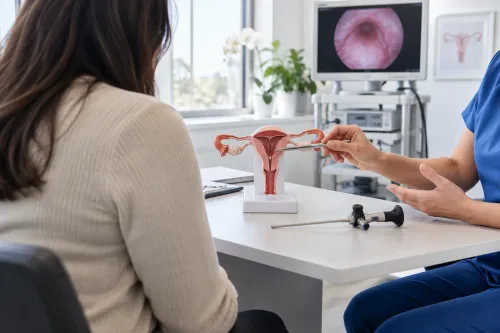
A first visit to a teenage gynaecologist in Thane usually begins with conversation, not an internal examination. The clinician may speak privately with the teenager about periods, medical history, medicines, allergies, mental health, sexual health, and safety. Height, weight, blood pressure, pulse, temperature, and an abdominal examination may follow.
| Parent or trusted adult | What to expect |
|---|---|
| Parent stays | Offers support while the teenager answers sensitive questions herself |
| Parent steps out | Gives private time for confidential health and safety questions |
| Teenager requests support | A trusted adult can remain for part or all of the consultation |
An internal pelvic examination is not automatic. Many first appointments need only history-taking and a general examination; an internal or other pelvic examination is considered when symptoms or examination findings make it necessary. Parents should avoid answering every question for the teenager.
Before the appointment, record:
- First day of each period, cycle length, and bleeding duration
- Pad or tampon use, pain score, and missed periods
- Acne, excess facial hair, and weight changes
- Medicines, allergies, and the possibility of pregnancy
Bring previous reports and a list of medicines. Encourage the teenager to describe what she feels in her own words.
How Do Confidentiality and Medical Tests Work for Teenagers?
At the beginning, the clinician should explain confidentiality: what you can discuss privately, what stays private, and what information may be shared with a parent or guardian. A teenager can ask for part of the consultation without a parent in the room, while choosing to involve a trusted adult for support.
Privacy has safety limits. The clinician must act if there is an imminent risk of serious harm, suspected abuse, possible sexual assault, or another legal safeguarding duty. They should explain what needs to be shared, with whom, and why, rather than disclosing information without explanation.
Tests should answer a clinical question, not follow every irregular period. The clinician may consider:
- A pregnancy test when pregnancy is possible.
- A complete blood count after heavy bleeding to check for anaemia.
- Thyroid-stimulating hormone and prolactin for absent or irregular periods.
- Androgen tests or blood glucose for findings such as excess facial hair, persistent acne, or suspected metabolic problems.
- A pelvic ultrasound for particular symptoms or examination findings, not automatically.
The choice depends on age, menstrual and medical history, examination, and symptoms. An adolescent women doctor in Thane should explain what each test could show, what it cannot show, and whether waiting, monitoring, or referral is safer.
How Are Heavy Periods, Pain, and Possible PCOS Assessed?
Heavy menstrual bleeding does not automatically mean disease, but it deserves assessment when it lasts more than seven days, soaks a pad or tampon every hour for several consecutive hours, includes large clots, or causes fatigue, dizziness, or breathlessness from possible anaemia.
An adolescent gynaecologist in Thane may take a personal and family bleeding-disorder history and order a complete blood count; reassurance alone can miss anaemia or von Willebrand disease.
- Arrange assessment for persistent severe pain, pain between periods, abnormal bleeding, or bowel and bladder symptoms; these features can point to endometriosis.
- Do not accept severe pain as an unavoidable part of adolescence, particularly when it has not improved after three to six months of suitable first-line treatment.
Acne or irregular cycles alone do not prove PCOS. In adolescents, diagnosis requires persistent ovulatory dysfunction together with clinical or biochemical hyperandrogenism, interpreted in the context of pubertal development. A single hormone result, polycystic-appearing ovaries on ultrasound, or cycle changes soon after menarche does not establish PCOS.
Pelvic ultrasound and anti-Müllerian hormone are not recommended to diagnose adolescent PCOS.
What Sexual Health and Preventive Care Can Be Discussed?
Sexual-health questions belong in adolescent care even when a teenager is not sexually active. A gynaecologist for girls in Thane should ask without assuming or judging; the discussion may simply clarify risks, boundaries, symptoms, or concerns.
Depending on the history, the clinician may discuss:
- Pregnancy testing when pregnancy is possible
- Contraception, including effectiveness, side effects, and protection from pregnancy
- STI screening or treatment
- HPV vaccination and cervical cancer prevention
- Support after coercion, unwanted contact, or sexual assault
STI screening depends on age, anatomy, sexual practices, symptoms, and risk—not sexual orientation. CDC guidance recommends annual chlamydia and gonorrhoea testing for sexually active women younger than 25, with additional testing when symptoms or specific risks warrant it.
The sample must match the exposure being assessed. It may be urine, a vaginal or cervical swab, or a swab from another exposed site, such as the throat or rectum.
WHO identifies girls aged 9–14 as the primary HPV vaccination group. The vaccine prevents new HPV infection; it does not treat an existing infection. Older adolescents should discuss the applicable Indian schedule and their individual circumstances with a clinician.
How Do You Choose an Adolescent Gynaecologist in Thane?
Choose an adolescent gynaecologist in Thane by testing the clinic’s process, not by relying on its label. Ask whether the clinician routinely sees minors, offers private time with the teenager, explains confidentiality before sensitive questions, and evaluates menstrual disorders, sexual-health concerns, and breast symptoms.
| Question | A useful answer | Warning sign |
|---|---|---|
| Does the clinic avoid unnecessary procedures? | History, general examination, and abdominal examination come first; internal examinations and tests are ordered only for a clear clinical reason. | Routine internal examination, ultrasound, or blood panel for every irregular period. |
| How are urgent problems handled? | Staff direct severe one-sided pain, fainting, fever with pelvic pain, sudden heavy bleeding, suspected pregnancy with pain or bleeding, or possible assault to urgent care. | A routine appointment is offered for a potential emergency. |
| Who provides additional support? | The clinic coordinates paediatric, endocrinology, mental-health, laboratory, and emergency referrals. | No named referral pathway. |
A teenage gynaecologist in Thane or an adolescent women doctor in Thane should explain laparoscopy’s indication, non-surgical options, fertility and ovarian-tissue implications, bleeding, infection, organ injury, anaesthesia risks, and the possibility that surgery will not find or cure pain.
Dr. Chandavakar's Apeksha Maternity & Nursing Home in Thane is one local option to assess against these questions.
Related service
Adolescent Gynaecologist Dr. Madhura Chandavarkar is a dedicated Adolescent and Gynecology Specialist practicing at Apeksha Maternity & Nursing Home, Thane. View service → |
Frequently asked questions
When should a teenager see a gynaecologist?
Arrange an assessment if there is no period by age 15, no menstruation within three years of breast development, very heavy bleeding, severe period pain, fainting, unusual discharge, or symptoms that disrupt school and daily life.
What happens at a first adolescent gynaecology appointment?
The doctor reviews menstrual history, pain, bleeding, medicines, health conditions, nutrition, and concerns. They explain any examination or test first; many first visits begin with conversation and do not require an internal examination.
Are adolescent gynaecology appointments confidential?
Ask the clinic to explain its confidentiality policy, including what remains private and when a safety risk requires involving a parent or guardian. The teenager can request time to speak with the doctor privately.
How are heavy periods, painful periods, and possible PCOS assessed?
Assessment includes cycle dates, bleeding volume, pain pattern, acne, excess hair growth, weight changes, medicines, and family history. The doctor may recommend a physical examination, blood tests, or ultrasound based on the symptoms.
What sexual health and preventive care can teenagers discuss?
A teenager can ask about consent, contraception, sexually transmitted infections, pregnancy concerns, vaccines, discharge, and safer sex. The doctor should explain privacy, testing, treatment, and follow-up in clear language.
Keywords